Por Inés Ahumada
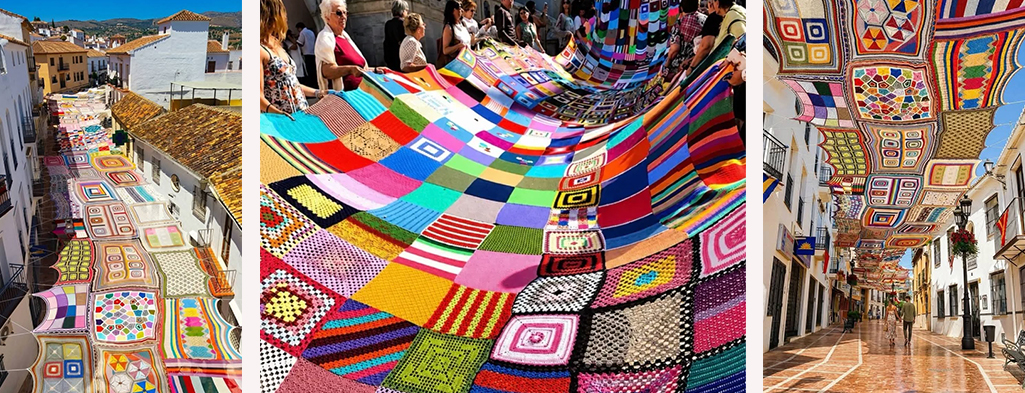
Suspended above a bustling, sun-drenched street in a small town in the south of Spain hangs an intricate canopy of colour, pattern and life. In the vibrant Andalusian town of Alhaurín de la Torre, where the relentless Mediterranean sun beats down on its polished marble streets, this handmade installation provides, beyond just shade, a vivid expression of community, culture and beauty.
The town is distinctly Andalusian: whitewashed facades stand, shoulder to shoulder, embellished with terracotta roofs and wrought-iron balconies, draped with tumbling santa ritas. Spindly café tables huddle against the sparse shade of these buildings. The small plazas are lined with trees bearing juicy fruit, oranges and lemons, and the citrus scent mingles with jasmine and the rich perfume of dark, cool earth. By midday, the heat will settle over the town like a heavy blanket, but the ‘toldo de croche’ turns the street into a kaleidoscope. Sunlight will filter through thousands of little stitches, scattering stirring mosaics of crimson, navy and amber onto the marble below. The breeze rustles the crochet panels, and, as the colours ripple, their shadows dance along, echoing your footsteps.
The “toldo de crochet”, as they call it, began over seven years ago in Eva Pacheco’s municipal crochet workshop, in January of 2019. Led by Pacheco, dozens of local women turned recycled yarn into colourful crocheted panels, initially conceived as environmentally friendly replacements for plastic awnings. Beyond its undeniable visual beauty, the canopy serves an ecological purpose, as a sustainable approach to public spaces, giving discarded materials a second life. Instead of a commonplace plastic awning, relying on mass-produced materials, the canopy was a gradual, handmade work of art, consciously respecting environment and culture. The toldo de croche embodies both the past and the future: it is the product of a technique centuries old, preserved across generations, while simultaneously representing the creativity and sustainability of the modern world.
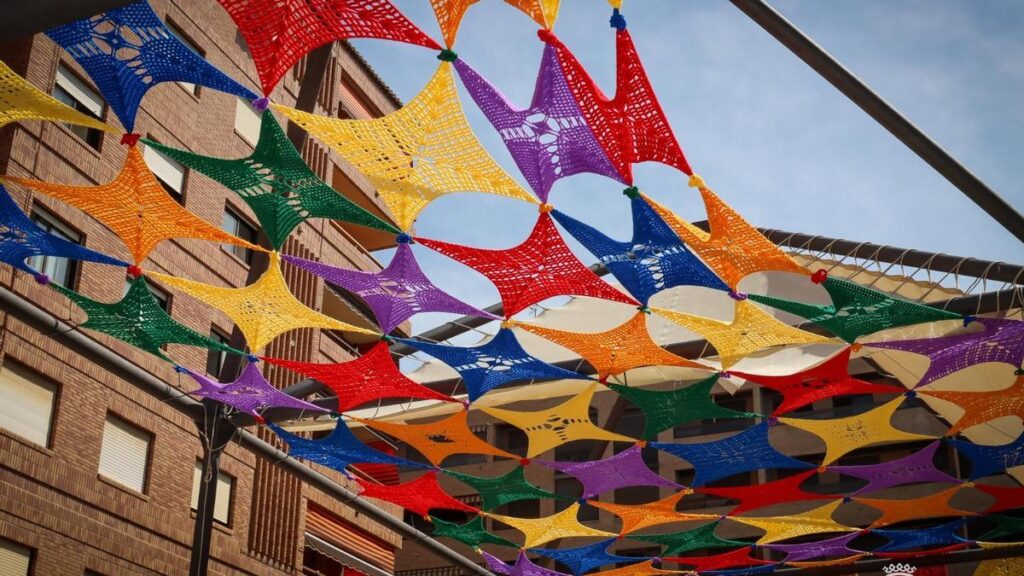
In both the weathered palm and the youthful paw, the yarn comes to life. In living rooms, workshops, and community centres, the hooks click as they weave recycled yarn. Experience guides youth, steering the gentle glide of hand, up and down, up and down. In the end, both the panel swiftly crafted by the seasoned grandmother and the one painstakingly assembled by the novice volunteer drift together beneath the sky, united into a single, vibrant whole.
Crochet is a textile craft that uses a single hooked needle to pull yarn through loops, which creates interconnected patterns. It is built one stitch at a time, unlike weaving, which stretches threads on a frame. Crochet can create anything from delicate lace to thick blankets—and, in this case, a monumental canopy. The technique became especially popular in 19th century Europe, particularly in Spain. Women adopted the craft, embedding it in domestic life. The technique was passed down through generations, as mothers, grandmothers and neighbours shared patterns and skills. Historically, it has been considered “women’s work”, as a quiet, domestic activity, often done while caring for children and preparing meals for the family. It was utilized to develop clothing, decorations and gifts, and was thus often overlooked, despite requiring immense precision and creativity from the crocheter. However, in recent times, crochet has been increasingly recognized, among other typically “female” crafts, and has risen in popularity as a form of art and culture. What was once confined to the home has now expanded to workshops, galleries and massive community projects, now covering this entire Spanish street.
The true artistry of the canopy lies in the hands that created it, stitch by stitch. Many of the women who gathered in public workshops, hands moving steadily over their hooks, are older residents who have carried the technique with them since birth. Many were born with a hook in their hands, and they have woven the threads connecting generations, through skills inherited from mothers and grandmothers, which they now work to preserve, on a much larger scale. A blanket that used to cover one, now provides shelter for thousands.
The modern world sees less and less of these handmade traditions. The domestic and artistic crafts that used to sustain households and cultures are now being lost to mass production and the never-ending industrial expansion. The laborious technique represents the forgotten art of slow craft, one requiring patience, repetition, and, above all, human touch. The products of a hand’s toil will inevitably be laced with love, or, at least, care. Many are dedicated to the preservation of crochet, and this installation serves as a testament to their efforts. Through countless hours and countless stitches, the women of Alhaurín de la Torre defy modern manufacturing, bringing a domestic activity out onto the streets, and lifting it up, up into the sky, daring anybody to forget about this beautiful technique.
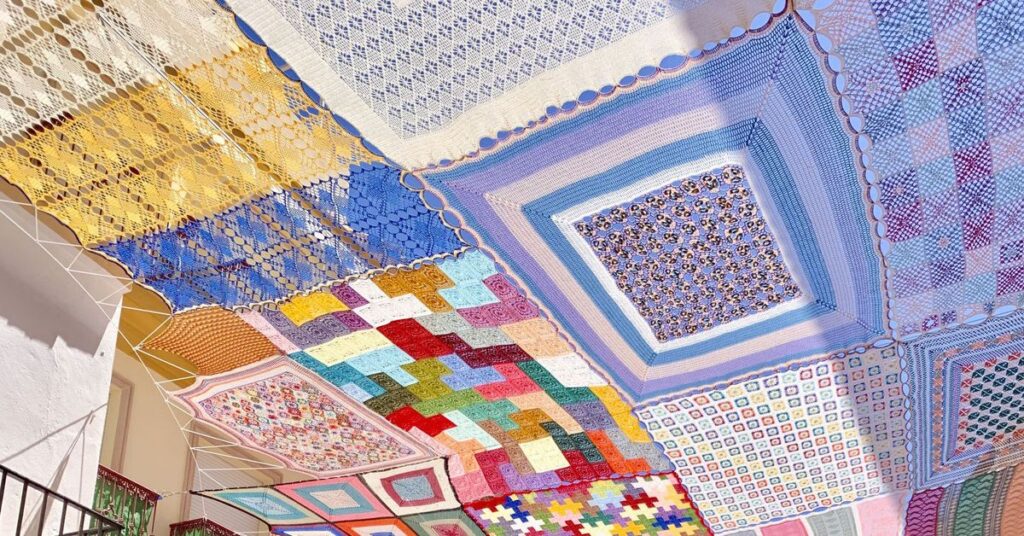
Although the project was initially meant to produce awnings, it soon expanded. The installation has continued to grow each year, and, in 2026, it hovers above Calle Málaga, a monumental crocheted canopy shading 150 metres of the main pedestrian street. Calle Málaga, home to the town’s most important businesses, including shops and cafés, can now offer locals shelter from the unbearable heat of the summer months. Those who used to hustle through the bustling street, hurrying to avoid the scorching heat, can now leisurely stroll on the marble pavement, taking their time with their summer shopping.
The project undoubtedly brings economic benefits as well. By cooling one of the town's most popular thoroughfares, it encourages pedestrians to linger, to wander languidly from bakery to boutique, to lounge on a café chair and unhurriedly sip an espresso. Yet its greatest draw is simply its aesthetic. The canopy, so vivid in colour and singular in design, invites visitors to pause, tilt their heads upwards and take the marvel in. To watch sunlight seep through millions of intricate stitches. As a symbol of local pride, passerbies will feel almost obliged to stop and gaze, as will tourists cradling their cameras.
Although the canopy is taken down as the warmer months come to an end, its absence is only temporary. Each panel is carefully washed, repaired, and stored away so as to preserve their beauty, until they return again a few months later, suspended above Calle Málaga. The installation’s fragility is part of its charm: the toldo follows the shift of the seasons around it. When summer calls for its shade, the canopy floats above the town. When the season fades and its purpose is for now fulfilled, it must be cared for and repaired, similarly to the way in which cultural traditions must be tended to, by the hands willing to work to preserve them. For the talented women of Alhaurín de la Torre, the toldo de crochet is more than a practical shade during the balmy summer months. It is a public monument to a technique that has united generations, and now unites an entire town beneath a colorful embrace. Woven from countless individual stitches by countless individual hands, the canopy weaves together, not only yarn, but the memory and pride of a community that persists.