Por Inés Ahumada

There is a particular kind of jealousy, the most shameful and agonizing kind, reserved for those we love. I have found that female friendships are where it runs most rampant. It is odd how the one dearest to you, the girl with whom you share so much, can also be the source of the most unbearable, tear-your-hair-out jealousy. It is not the resentment of strangers, nor the hatred of enemies, but the pain of seeing those closest to you embody all that you desire. That is the case in Elena Ferrante’s Neapolitan Quartet, which follows the complex, lifelong bond between Elena and Lila as they grow up in a poor neighbourhood in Naples, Italy in the 1950s, until they reach old age. The first novel, “My Brilliant Friend”, narrates Elena’s youth, as she befriends Lina and they begin to navigate both the difficult worlds of education and society in their working-class town.
Elena’s envy towards Lila begins in the form of an academic rivalry, as early as elementary school. Elena is the best in the class and is praised for her efforts by the teacher. Meanwhile, Lila is initially a disruptive, mischievous child who launches bullets of ink-blotted paper at her mates, but she soon demonstrates a profound, innate intelligence. She readily grasps any concept taught, challenges authority without hesitation, and seems to possess a brilliance that knows no bounds, evident even at the age of seven. Try as she might, Elena, despite the hours she spends studying, inevitably lags behind. Lila’s genius is not limited to school: she displays an incredible capacity to understand people, to solve problems, and to confidently defy the limitations placed on her. Elena watches as Lila constantly outdoes her. While she eventually makes peace with second place, she is perpetually thwarted by her best friend’s effortlessness; Lila is not competing with her. Achievement seems to chase her, while Elena chases achievement. And this is precisely why her envy never darkens into resentment. Lila’s deftness serves as both an inspiration and a frustration, spurring her to apply herself, while serving as an agonizing reminder of what she does not naturally possess.
As elementary school comes to an end, the teacher encourages both Lila’s and Elena’s parents to pay for the middle school entry exam, assuring them of their offspring’s academic proficiency. Elena’s parents support her and allow her to continue her education, but Lila’s father refuses, and, in a fit of rage, throws his daughter out the window, breaking her arm. Thus, Lila, the brilliant friend, is confined to work at her family’s shoe store, much to the relief of Elena, who, deeply affected by her inferiority complex. relishes the opportunity to finally excel, alone. Nevertheless, Elena soon finds that, without Lila’s intellectual companionship and rivalry, her blazing desire to learn dims. It is clear that Elena’s success is founded on the need to compete with Lila. Meanwhile, Lila does not allow her lack of formal education to stop her learning: she secretly continues to study, surreptitiously checking out a plethora of books each week, and follows her friend’s education from afar. When Elena learns that Lila has devoured the Greek grammar book that Elena has been labouring over, her envy reignites. Lila recognizes her role in her friend’s success, and manipulates her jealousy to force her to appreciate her academic opportunities. Eventually, however, she focuses all her efforts towards the family business. Dust gathers on her books, and, in parallel, on Elena’s, who no longer sees a point in the intellectual career she once saw as her future. Her ambition is paradoxically dependent on the very person whose brilliance she envies. Without Lila as a rival, Elena sees no milestones ahead, feels no fire within her. Lila is on another path, and once Elena sees she’s alone on hers, what is the point in continuing forward? She has no one to outrun, and, thus, she stops running.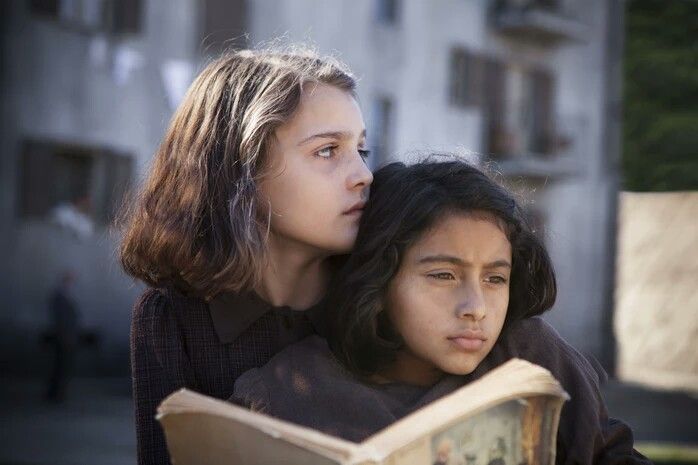
Elena comforts herself with what she does possess. She reassures her wretched prepubescent self, curly-haired and tidy, with the fact that she is prettier than Lila. This reassurance of physical superiority is fundamental for Elena’s vanity. Scrawny, dark and wild, young Lila is not conventionally beautiful, at least not the way Elena understands it: she is not the cheerful, fair girl that Elena sees in the mirror. From the very beginning, the friends are presented as physical opposites. However, as the girls enter puberty, this hierarchy begins to upend. Plagued by typical teenage struggles: baby fat, glasses, acne, exacerbated by the physical exhaustion of school, Elena gradually loses confidence in her appearance. Simultaneously, she watches as Lila grows into her thin frame, her sharpness, and her dark features, maturing into a striking beauty that Elena cannot match. Lila is soon capturing the attention of many of the men Elena wished would look her way. As the girls begin to practice their dancing and attend parties, this becomes even more evident: all the young men, even the unattainable Marcello, want to dance with Lila. In fact, so fervent is their desire that they begin to fight over her. When Lila marries Stefano, a wealthy grocer, she enters a world of affluence that was unknown to her, impossibly distant from yet coexisting with their impoverished neighbourhood. Stefano spoils her, showering her with expensive gifts and dressing her up in stylish outfits, so that Lila walks down the run-down streets looking like she stepped off the pages of a fashion magazine. She has transformed; no longer a wild, skinny creature, but a sophisticated lady, next to whom Elena feels painfully ordinary.
To Elena, Stefano is evidence of the universe rewarding Lila: intelligence, beauty, charm, wealth. Elena, who grinds away at her books, has nothing to show for it. And so, she fears, life will repeat this agonizing cycle, and she will have to work twice for half of what Lila boasts. It is ironic how Lila, so confined by her circumstances, is the one who has escaped them, now possessing the beauty, confidence and luxury that Elena believed would one day find her. What good is education, she asks, watching as Lila effortlessly transitions into the adult wealth and status they so desired. In reality, Lila’s marriage proves to be another cage—one made of gold, but a cage nonetheless. However, in Elena’s eyes, the wedding ring is salt on her wound. It is yet another something wrapped around Lila’s finger, yet another reminder of Elena’s own inadequacy, yet another achievement that she lacks.
Ferrante masterfully understands that Elena’s jealousy is not so much for the things that Lila attains. Elena does not want Stefano for herself, nor does she wish for Lila’s beauty. She might be anguished by her friend’s brilliance, but, more so, she longs for the ease with which Lila attains all she is blessed with. While Lila glides towards the summit, Elena must claw her way up the mountain, and it seems she will claw forever, in pursuit of her friend and the sheer effortlessness that runs in her veins.
Perhaps this is why My Brilliant Friend resonates with so many. We have all had a Lila (or many) in our lives, to some degree. There is always someone who, in their superiority, has pushed us to be better. Someone whose gifts have shed light on the limits of our own. It must be noted, however, that Elena’s envy was not one-sided. Though we do not have direct insight into her mind, it is clear that Lila also envied Elena: Elena possesses the education and freedom that Lila lacks, and so Lila is also forced to watch in anguish from afar, from inside her golden cage.
Although a cliche, it remains that the grass is always greener on the other side.